

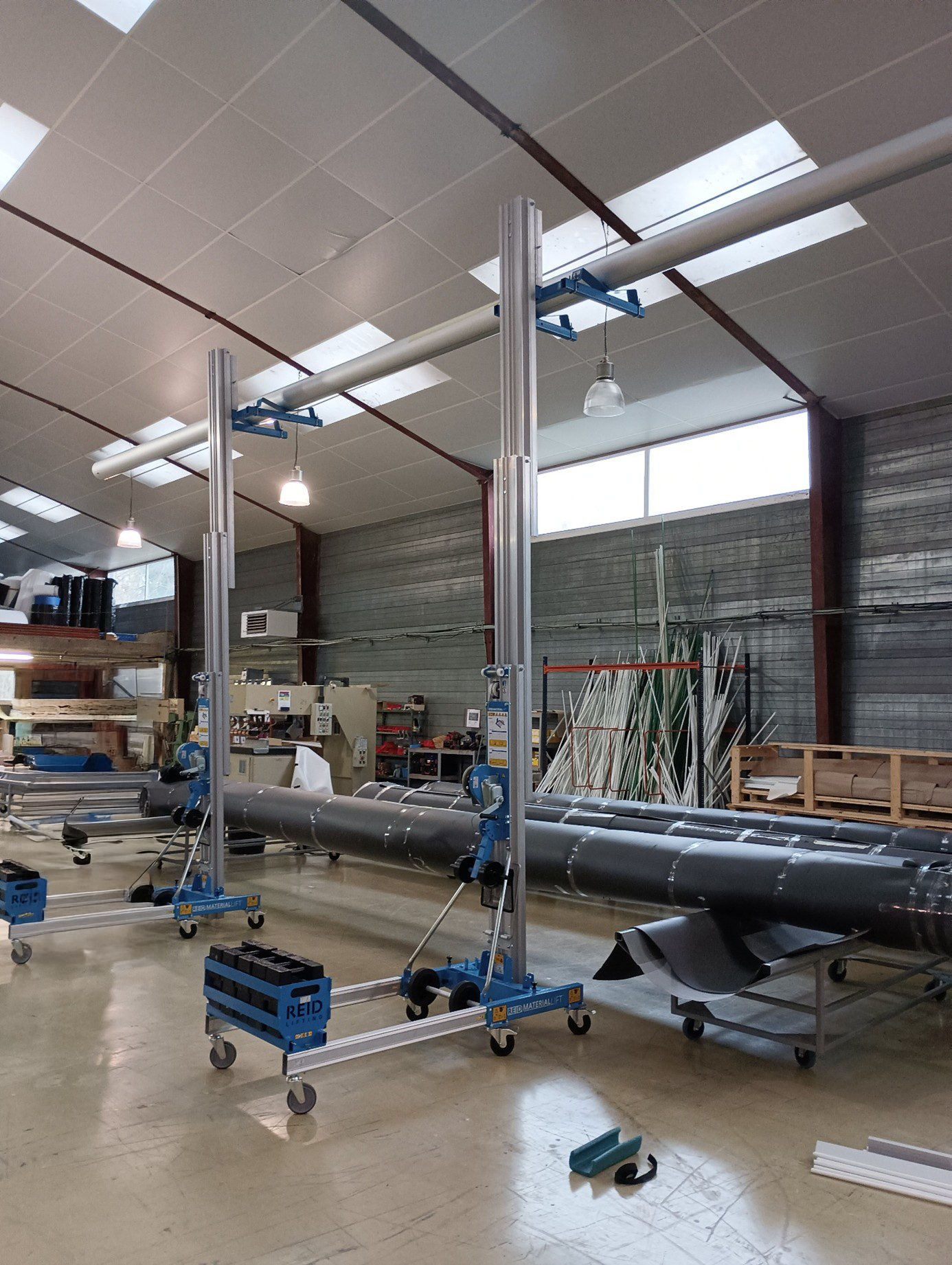
Preparing large-span pool cover installations, with two Reid Material Lifts
Overview
CIFFA Systèmes designs and manufactures bespoke covers for industrial infrastructure and public facilities. Among that work is the installation of thermal covers for public swimming pools.
The company recently invested in two Reid Material Lifts, RML45 model, to handle the long roller shafts these installations involve. Before taking the equipment on site, the team ran a series of workshop tests to confirm the configuration and work through the practicalities in controlled conditions.

The Challenge
A pool cover roller shaft is not a difficult load in itself. What makes it awkward is everything around it.
- The shaft is too long for a single lift. Supporting it at one point alone would leave it unstable and put the whole assembly at risk. Two lifting points have to work together.
- The work happens at the pool edge. The equipment needs to reach as close to the water as possible, which rules out a base that has to sit squarely under the load.
- The load is cylindrical. Standard forks are designed for pallets and flat loads. A round shaft needs a cradle that holds it securely without letting it roll.
- Every site is different. Access routes, floor conditions and the space available around the pool vary from one facility to the next, and are rarely known in full before arrival.
Strategy & Approach
CIFFA Systèmes chose two RML45 units, used together so that each supports one end of the shaft. The RML45 offers a height of lift of 4.5 m and a maximum capacity of 360 kg, well within what these assemblies require.
Both units are set up in counterbalance configuration. Rather than sitting under the load, the lift is balanced by a basket of weights at the rear, which allows the mast to work right up against an edge or a wall. That is what makes it possible to position the shaft close to the pool. Switching between forward facing and counterbalance takes minutes and needs no tools.
Each lift is fitted with the pipe cradle attachment, which is designed to support pipes and ducting and suits the long cylindrical shafts used on pool rollers.
One point deserves attention on this kind of application: in counterbalance configuration, the working load limit changes with the load centre. The further the load sits from the mast, the lower the capacity. Establishing that distance is part of what the workshop tests were for.
Why test in the workshop first
Running the configuration in the workshop, before any site visit, let the team confirm the equipment pairing, anticipate access constraints and train on the assembly in a controlled environment rather than at the pool edge on installation day.


